
Anna-Sophie Berger, Oroma Elewa, Julie Falk, Haruck Farocki, Lourdes Grobet, Runo Lagomarsino, Twan Lugten, Céline Mathieu, Jacqueline Mesmaeker, Jonathan Monk, Gozié Ojini
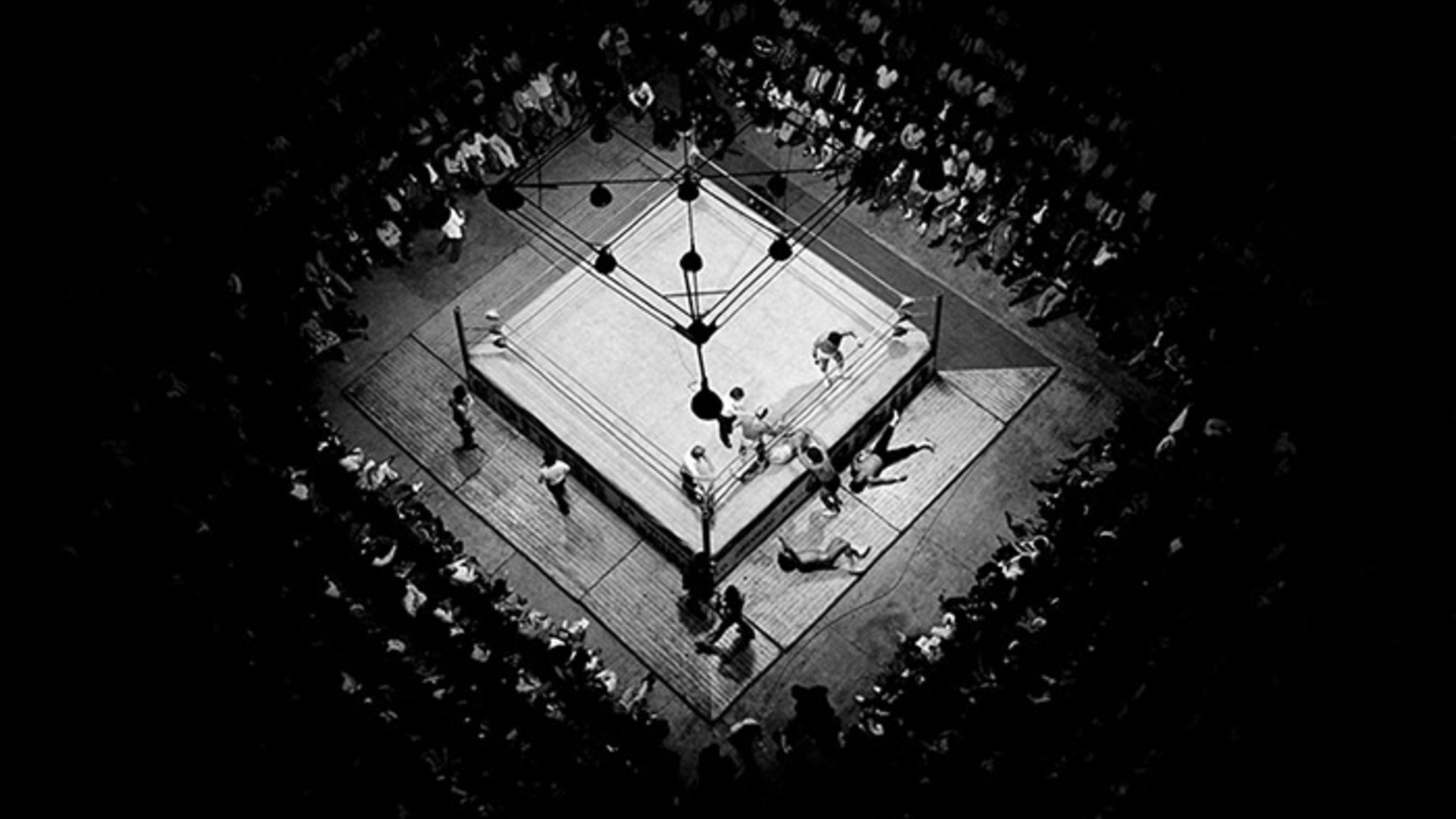
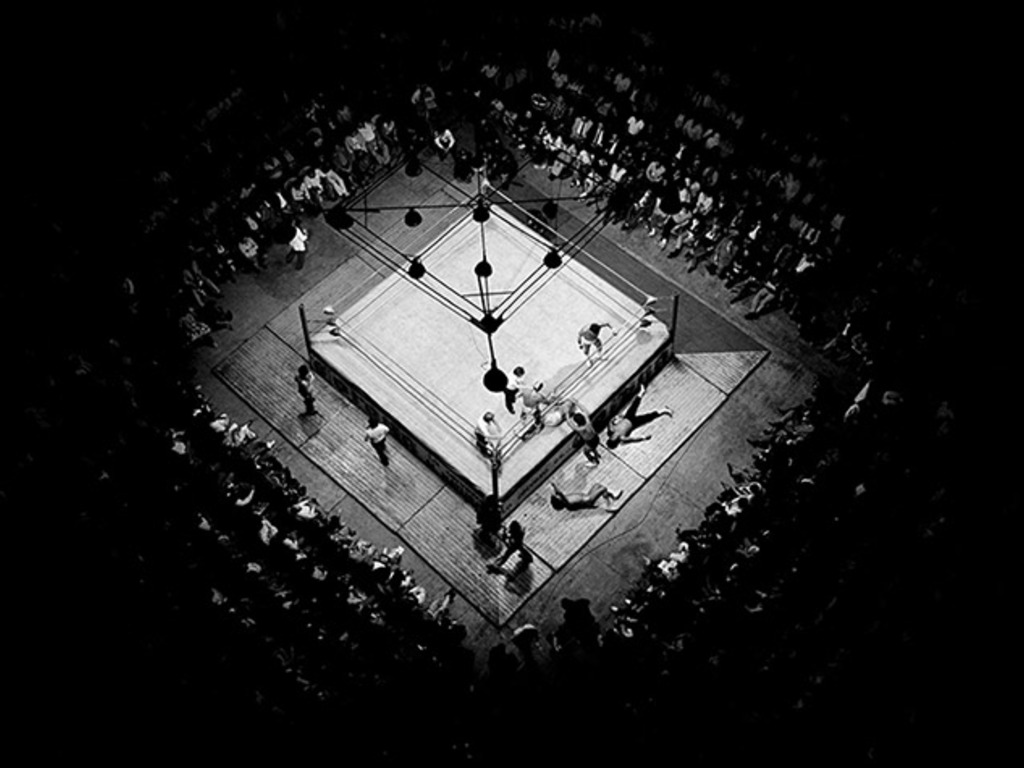
Wrestling is humanity’s longest standing excuse for an oiled-up pair to embrace in public. In Greek palaestra, to Turkish yağlı güreş, where olive-drenched pehlivans reach for a grip inside each other’s leather trousers, continuously intimacy is staged as combat. Iran’s zurkhaneh turns it into a ritual, with drums, Ferdowsi recitation and swinging clubs. Mongolian bökh wrestlers flap in open-chested vests, sumo makes sacred heaviness out of loincloths and salt. American wrestling took out the grip and scripted it. Roland Barthes saw this coming; he wrote wrestling is not sport but spectacle (1), a morality play of pure gesture. “The public is completely uninterested in knowing whether the contest is rigged or not, and rightly so.”(2) It had come for “the great spectacle of Suffering, Defeat, and Justice,”(3) where the wrestlers laid small shifts in their stances open for symbolic interpretation. He also wrote where this stops working: when a wrestler lays it on too thickly the crowd turns on him, “because it condemns artifice.”(4) Everyone present knows the fight is arranged; they don’t object out of a longing for real suffering, but will at the point where it’s noticeably scripted badly. (5)
The piledriver begins with a complete reversal of the body. One wrestler is held upside down against the others body, with their legs raised and head pointed toward the mat. The pause before the body is brought down allows the audience to read the scene: one body has gained absolute control over another. A body becomes an object, suspended for a moment before its apparent destruction. The wrestler down tucks their own chin and takes the impact across the shoulder. The minimal gesture may be obvious, but is most of what stands between a neatly choreographed movement and a broken neck.
A machine that lifts a weight and drops it onto a pile is also called a piledriver, piercing over and over until the soil stops giving way. As the pile enters, the ground’s resistance becomes part of what supports the structure. Gilbert Simondon – Barthes contemporary – named this aspect associated milieu (6). He’d describe it as an object that needs to draw part of its surroundings into its own functioning, until the thing it works against becomes a working component. The machine runs on resistance and cannot work against anything that does not push back.
The 1980s WWF made the resistance of morality geopolitical. Hulk Hogan, tanned, blond, bandana’d, defeated the Iron Sheik at Madison Square Garden. In doing so he rescued the nation from an Iranian villain, waving the flag of a country that had recently held Americans hostage. Irony had it that Hossein Khosrow Ali Vaziri was a genuine Greco-Roman wrestler. The real athlete played the cartoon ‘villain’, while the cartoon became America. The wrestler’s neck gets thicker where it has been hit.
1, 2, 3 ,4 Roland Barthes, “The World of Wrestling,” in Mythologies, 1957; trans. Annette Lavers, 1972.
5 “Now It Can Be Told: Those Pro Wrestlers Are Just Having Fun,” The New York Times, 10 February 1989.
6 Gilbert Simondon, Du mode d’existence des objets techniques, 1958.
Temporary Address:
Stadhuisplein 3,
5611 EM Eindhoven (3rd floor)
www.vanabbehuis.nl
Open
Thu–Sun 13:00–17:00
Curated by Fréderique Scholtes and Rawad Baaklini
Assistant curator: Kimiya Jahanshahi
Run: opening 13 November 2026, closing Jan-Feb 2027
Van Abbehuis, Eindhoven
Opening with performance by Lagomarsino, a reading by Céline Mathieu, and a performance by intermittent fasting.
Curated by Fréderique Scholtes and Rawad Baaklini
Assistant curator: Kimiya Jahanshahi
Run: opening 13 November 2026, closing Jan-Feb 2027
Van Abbehuis, Eindhoven
Opening with performance by Lagomarsino, a reading by Céline Mathieu, and a performance by intermittent fasting.
Wrestling is humanity’s longest standing excuse for an oiled-up pair to embrace in public. In Greek palaestra, to Turkish yağlı güreş, where olive-drenched pehlivans reach for a grip inside each other’s leather trousers, continuously intimacy is staged as combat. Iran’s zurkhaneh turns it into a ritual, with drums, Ferdowsi recitation and swinging clubs. Mongolian bökh wrestlers flap in open-chested vests, sumo makes sacred heaviness out of loincloths and salt. American wrestling took out the grip and scripted it. Roland Barthes saw this coming; he wrote wrestling is not sport but spectacle (1), a morality play of pure gesture. “The public is completely uninterested in knowing whether the contest is rigged or not, and rightly so.”(2) It had come for “the great spectacle of Suffering, Defeat, and Justice,”(3) where the wrestlers laid small shifts in their stances open for symbolic interpretation. He also wrote where this stops working: when a wrestler lays it on too thickly the crowd turns on him, “because it condemns artifice.”(4) Everyone present knows the fight is arranged; they don’t object out of a longing for real suffering, but will at the point where it’s noticeably scripted badly. (5)
The piledriver begins with a complete reversal of the body. One wrestler is held upside down against the others body, with their legs raised and head pointed toward the mat. The pause before the body is brought down allows the audience to read the scene: one body has gained absolute control over another. A body becomes an object, suspended for a moment before its apparent destruction. The wrestler down tucks their own chin and takes the impact across the shoulder. The minimal gesture may be obvious, but is most of what stands between a neatly choreographed movement and a broken neck.
A machine that lifts a weight and drops it onto a pile is also called a piledriver, piercing over and over until the soil stops giving way. As the pile enters, the ground’s resistance becomes part of what supports the structure. Gilbert Simondon – Barthes contemporary – named this aspect associated milieu (6). He’d describe it as an object that needs to draw part of its surroundings into its own functioning, until the thing it works against becomes a working component. The machine runs on resistance and cannot work against anything that does not push back.
The 1980s WWF made the resistance of morality geopolitical. Hulk Hogan, tanned, blond, bandana’d, defeated the Iron Sheik at Madison Square Garden. In doing so he rescued the nation from an Iranian villain, waving the flag of a country that had recently held Americans hostage. Irony had it that Hossein Khosrow Ali Vaziri was a genuine Greco-Roman wrestler. The real athlete played the cartoon ‘villain’, while the cartoon became America. The wrestler’s neck gets thicker where it has been hit.
1, 2, 3 ,4 Roland Barthes, “The World of Wrestling,” in Mythologies, 1957; trans. Annette Lavers, 1972.
5 “Now It Can Be Told: Those Pro Wrestlers Are Just Having Fun,” The New York Times, 10 February 1989.
6 Gilbert Simondon, Du mode d’existence des objets techniques, 1958.
Temporary Address:
Stadhuisplein 3,
5611 EM Eindhoven (3rd floor)
www.vanabbehuis.nl
Open
Thu–Sun 13:00–17:00