
Two words are written on a black suitcase. ‘Free will’ is the premise this building once rested on, as a court – now memorial center – cannot assign guilt without the assumption that the person in front of it could have done otherwise. In Beckett’s play Waiting for Godot (1), a man is led on at the end of a rope carrying luggage, and he holds the bags for as long as he is in front of us, while he is discussed, while he is insulted, while nothing at all happens. Nobody has tied him to them.
Eventually, somebody asks why he does not put them down, and the answer that comes back is that he is hoping to not lose his job. The bags stay up. Painting, as it is, has a long habit of handing abstractions something to carry. Whatever else free will is, in this room it becomes luggage: carried rather than inhabited.
In 1998, beside a Spanish swimming pool, Gertjan van Leeuwen founded a society against humour. He called it the Bond tegen Humor, reasoning that everything else in the world had by then survived a joke, except the joke itself. Sianne Ngai argues that a single judgment of a joke would be too unstable (2): as to call a thing a joke is to already have been detained by it. Every joke runs on borrowed stability: a convention held steady just long enough for one’s departure from it to register as a departure at all.
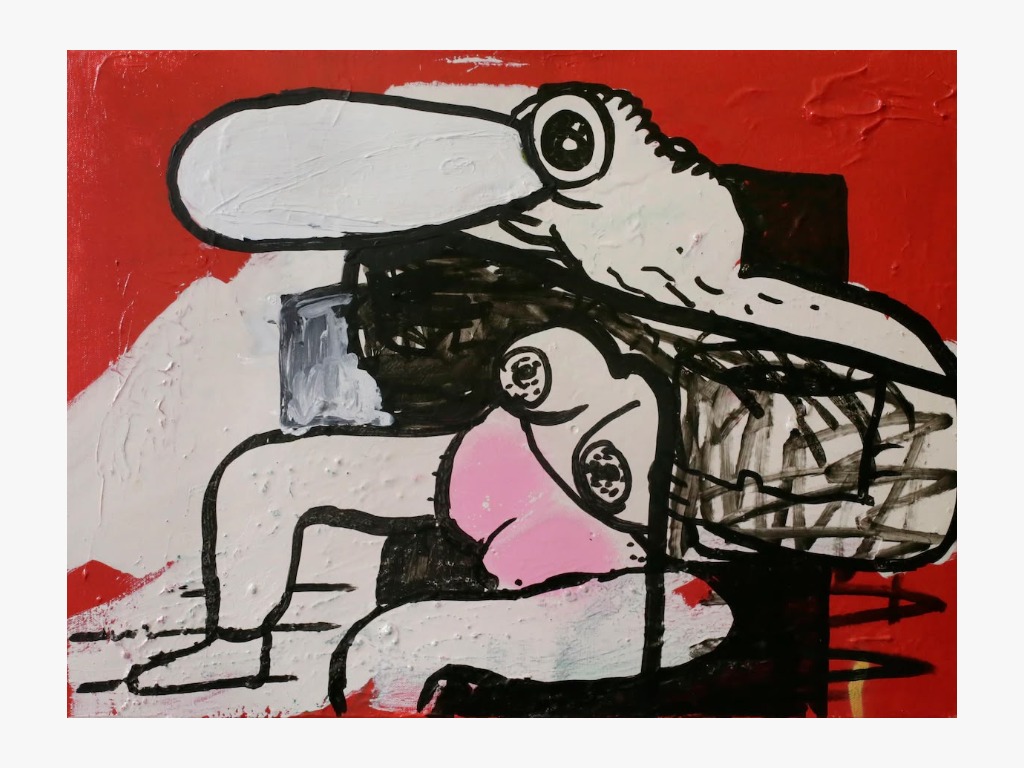
The painting the exhibition takes its title from is a canvas covered in thick off-white housepaint, with Liberta Totalemente lettered across the top in red and a small black metal figurine fixed near its middle. The support sustains the object at the exact moment the object threatens to pull the paint off the wall. The figure has been stripped of colour, with no evidence of allegiance: just bare posture in the midst of a forward movement. Its weight seems to drag down the canvas entirely. Conviction and evidential collapse, in this figure, become indistinguishable, formally the same pose.
The same misfiling can be found in sloganeering titles that arrive either from mishearing (Knowledge is a Fence), pictorial paradox (Two Minds postcard) and flattened aggression (Beating Up Normal People). The violence, though, rarely settles on a distinguishable target, making them seemingly devoid of political agenda. Alenka Zupančič wrote that comics carry types that cannot be discouraged, that absorb every humiliation and return unfazed for their next confrontation. (3) In The more rich, the more afraid, who the exact receiver is remains ambiguous. It borrows the machinery of caricature, without having to carry the payload of an actual being behind it. As in his cartoons, but reduced in punchlines, the paintings take a joke and remove the body, so the holding falls to the canvas.
Consequently, the laughter that follows doesn’t relieve the tension the painting produces, but redistributes it to whoever’s still standing in the room: passers-by pictured outside the frame, not closing the circuit to the one that stands in front of it. Laughter locates you: it tells other bystanders what you are prepared to find funny. Remaining silent signals another mode, one of being clued in already, informed enough to remain contemplative, or beyond mortal reactionary reflex altogether. Gummbah has spent a parallel career drawing this same room: visitors performing appreciation or embarrassment in front of canvases that may not have earned it, museum guards in states of low-grade confusion. Standing in front of a yellow smear, working out whether you are permitted to enjoy it, you are inside a cartoon that was published years ago.
1. Waiting for Godot: A Tragicomedy in Two Acts (London: Faber and Faber, 1956)
2. Theory of the Gimmick: Aesthetic Judgment and Capitalist Form (Belknap/Harvard, 2020) and Comedy Has Issues, Lauren Berlant and Sianne Ngai, Critical Inquiry 43 (Winter 2017).
3. The Odd One In: On Comedy (MIT Press, Short Circuits, 2008), Part I, ‘The Universal-at-Work’
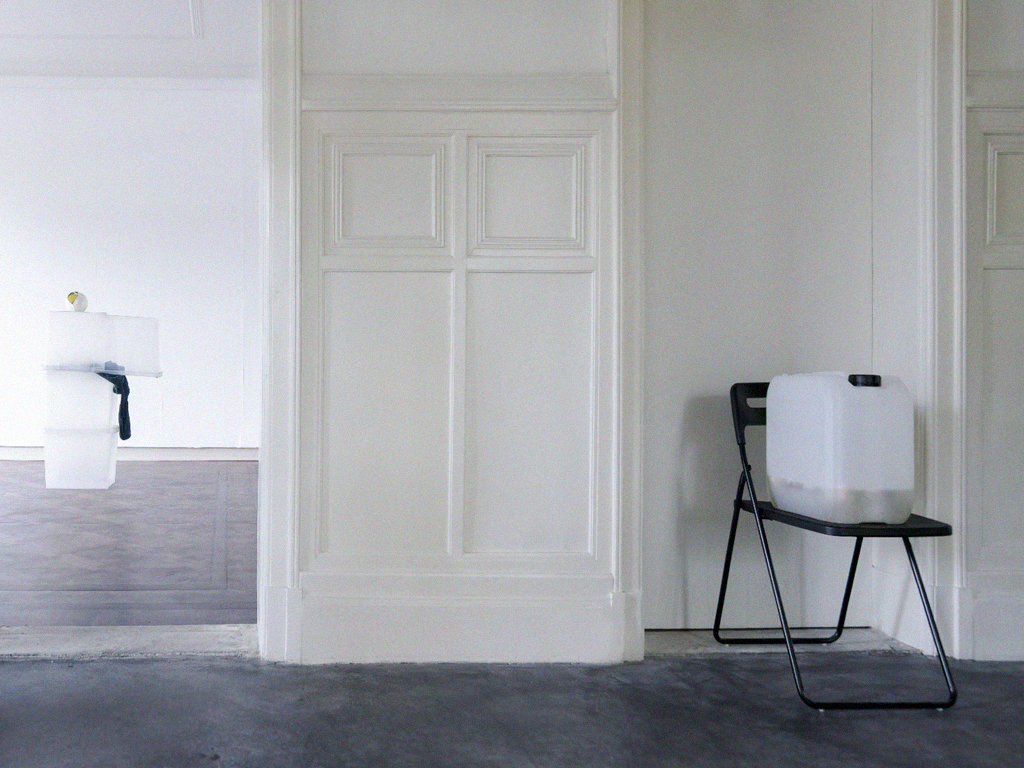
In Van Abbehuis, some works are installed that bring together artists from different centuries. The works remain in place and unfold as an ongoing dialogue, where each piece responds to what came before and influences what follows.
This approach can be traced back to the leaded glass work by Toon Berg, installed in the Billiard room in 1926. Like a house holding traces of its previous inhabitants, Van Abbehuis carries past stories, gestures, and uses. Each artist leaves something behind, adding ongoing contributions, materials, and forms that move through the building and reappear across the space. The collection accumulates over time and is connected to its history as well as its current context, so that revisiting earlier works is just as important as establishing new projects.
In 2025, Tom Marioni accumulated in this narrative with the work Café Wednesday through his work The Act of Drinking Beer With Friends is the Highest Form of Art. Mira Dayal responded by transforming the concrete floor; and during a benefit weekend, Cem A. installed Angry Peace Flag on the flagpole. In 2026, Olivier Goethals created the installation Duif. Through this work, he makes an intervention that interconnects both the role of the host and the visitor, responding to the historic entrance like a silent host.